
Ron Ahnen’s 7-year-old sister, Rose Marie “Rosie” Ahnen, was murdered in Wisconsin in 1973. The man responsible, Jack Bailey, would spend the next 53 years in prison. In 2010, Ron met with Bailey through a restorative justice program at Marquette University Law School. However, Bailey never apologized or admitted responsibility.
Ron, now a politics professor at Saint Mary’s College of California and an ordained Unitarian Universalist minister, moderated a recent screening of THE WINDOW ON DEATH ROW at Saint Mary’s College of California. After the screening, audience members asked him about forgiveness and what it means to oppose the death penalty when someone you love has been murdered.
With Ron’s permission, we are sharing these exchanges.
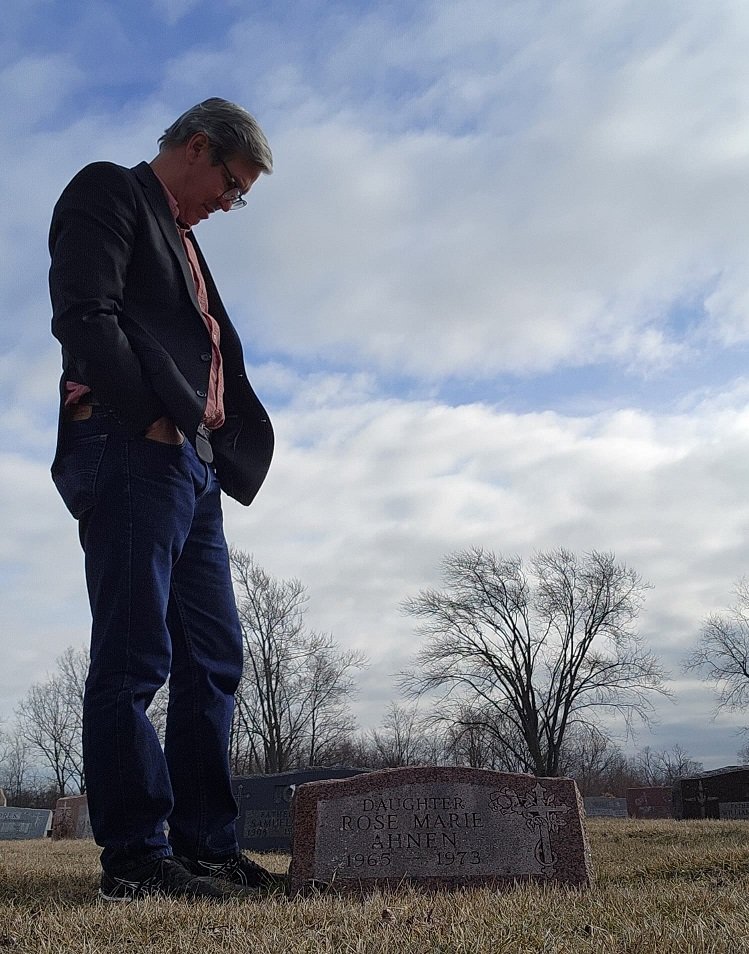
50 years after her murder.
After your sister’s death, what were your conversations with your mom like about forgiveness? Did you always agree with her or did it take time?
I didn’t speak with my Mom directly about forgiveness, actually. I can say that my mother was a very understanding, kind, and forgiving person. Rosie’s death took a lot out of her, especially at that time. What I do have is a statement that she wrote by hand the first time that Jack Bailey was up for parole. She explained to the parole board that she felt Bailey was a danger to other people, but also noted that she didn’t bring her kids up hating him. And that is true. We never talked about Bailey, but nothing bad was ever said about him either.
With Jack Bailey, you had no redemption or possibility for change. However, people use the idea of a redemptive period and an incarcerated person’s ability to change as a case against the finality of the death penalty. How do we reconcile those two things?
Hope. There is always hope. From the first time I contacted Bailey when I was 20 years old to the last time I heard his voice in his last parole hearing, he denied what he did. Again, the evidence is overwhelming that he did it. But there is always a chance that someone will see the error of their ways. He didn’t, which is why he died in prison.
Yet hope for redemption is not the only reason we refuse to put people to death as a punishment. Taking a person’s life–no matter how seemingly justified on the scales of justice–still takes something out of us. It says more about the rest of us than it says about the person to be executed. You can hate the harm they caused just as much without demanding they be put to death. I find that people who think they will find a special sort of closure after an execution often only end up with feelings of emptiness—or worse yet, they find the pain they carried for so many years still goes on—a pain they thought was going to be alleviated. The pain of the harm does not go away. Ever. And if someone does feel more satisfied when someone is put to death, I feel sorry for that person because I do believe they are acting from a place of revenge and hurt rather than love and forgiveness. And leading one’s life from a place of revenge and hurt is hard, it’s exhausting, it’s stressful, and ultimately, unsatisfying.
But how did you feel? Did you experience a crisis of faith when restorative justice was not possible?
My experience of my “crisis of faith” was when I thought deeply about the problem of theodicy: how can a just, loving, merciful, and all powerful God allow for such pain and suffering? Because if I were God and I saw my sister just about to get kidnapped, and I could have done something about it, I would have. And if I would have, why wouldn’t God? So I concluded that the only way I could believe in God is to believe that after creation, God set it all in motion and doesn’t suspend the laws of nature from time to time.
I couldn’t believe God heals cancer, or lands the plane safely, or gets you through the surgery, or finds you a parking spot in a crowded lot. That’s the only way I could continue to believe in God. And it turns out that such a God is somewhat interesting to speculate about, but not in fact significant when it comes to dealing with life. So I began to rely less and less on my relationship with God, and more on how to love myself and others. What really shaped my spiritual journey is not Jack’s inability to admit his guilt and refuse to ask for forgiveness, but the fact that Rosie was killed in the first place.
I knew all that when I went to see Jack, and I went with two goals in mind: to understand why/how this happened, and to give him one last good chance to say sorry and ask for forgiveness. I did accomplish the first goal, both on that day and over time listening to his parole healings. Jack grew up learning how to lie about everything in his life, and he continued to lie at his parole hearings–even about me. He never showed remorse. I understand from his background that he was emotionally scarred from his childhood and never was able to figure out a decent path for his life. The murder of a seven year old girl was out of the ordinary for him. He had a long list of criminal activity from robbing banks to bar fights to indecent exposure. It’s really too bad for my sister that our society just can’t figure out how to help people who need help. If we did, she would be alive today.
So my sister’s killing, and my many years of contemplating what it means for me with respect to my faith, woke me up. You could call it a “crisis” if you want, but I would say it was an awakening. I think I understand life much better now, though in a very different way from my upbringing. I am a religious natural humanist in the Unitarian Universalist faith , and I center my life on how to love others—including Jack. He treated my sister as an object, but I treated him with love and respect by holding a conversation with him. So I have a different way of understanding the divine, religion, faith, and ultimately, how we can always reach out to each other in love, no matter what happens. No matter what.